Managing the Employee Engagement Spectrum

David Crawford / January 16, 2026
Have you ever been in situations like these?
Your star developer didn't show up for work today. Again. You check the project management tool and see that their tasks are overdue. You send a message, but there's no response. Frustrated, you wonder if they are even committed to the team.
In the last three meetings, your project manager has been unusually argumentative, often dismissing others' ideas and insisting on their own way. The team dynamics are suffering, and you worry about the impact on productivity.
The last project went way over budget, and your Tech Lead didn't sound any alarms until it was too late.
A junior developer that you coach has been taking a lot of initiative lately, but the rest of the team isn't ready to trust them with more responsibility.
These scenarios highlight real problems that can arise in managing employee engagement. It's complex, and it's a delicate balance. If ignored, the consequences can be BAD. This blog post will walk through the stages of the engagement spectrum, and my advice on some concrete things you can do to manage it effectively.
Understanding Engagement
I've worked with many team dynamics over the years, from fully remote, to hybrid, to fully in-person. I've been in a lot of roles and industries, and what they all have in common is employees always fall somewhere on the engagement spectrum. We always want to be in the "highly engaged" zone, and we always want our employees to be there too. And when they're not, people tend to point fingers. I've heard it all:
"If we could just have remote as an option, they'd be more engaged." - When I worked in a fully in-person office.
"If we just had in-person time, we would spot the problems easier." - When I worked in a fully remote team.
"If we just had more opportunities, they'd be more engaged." - When I worked in a hybrid team.
But this is not about location or perks. There's a fundamental issue at play here, and we're not going to look at "where you're at" right now, but actually "how you got there" in the first place.
The Spectrum in Detail
If you google "engagement spectrum," you'll find a lot of random diagrams showing similar concepts of "low engagement" to "high engagement." These are adapted from Changing Behavior in Organizations by Arnold S. Judson in 1991. What I've done below is create my own version, one that I hope isn't as boring and actually has a lot more depth behind it. I thought that adding the actual inputs going in as "light" and a prism to interpret them into the colorful spectrum would help make the underlying concept clearer.
From my own interpretation, the engagement spectrum exhibits many different behaviors, which are triggered by change. Change goes into an organizational structure, where it's interpreted by individuals, and then results in behaviors that can be observed.
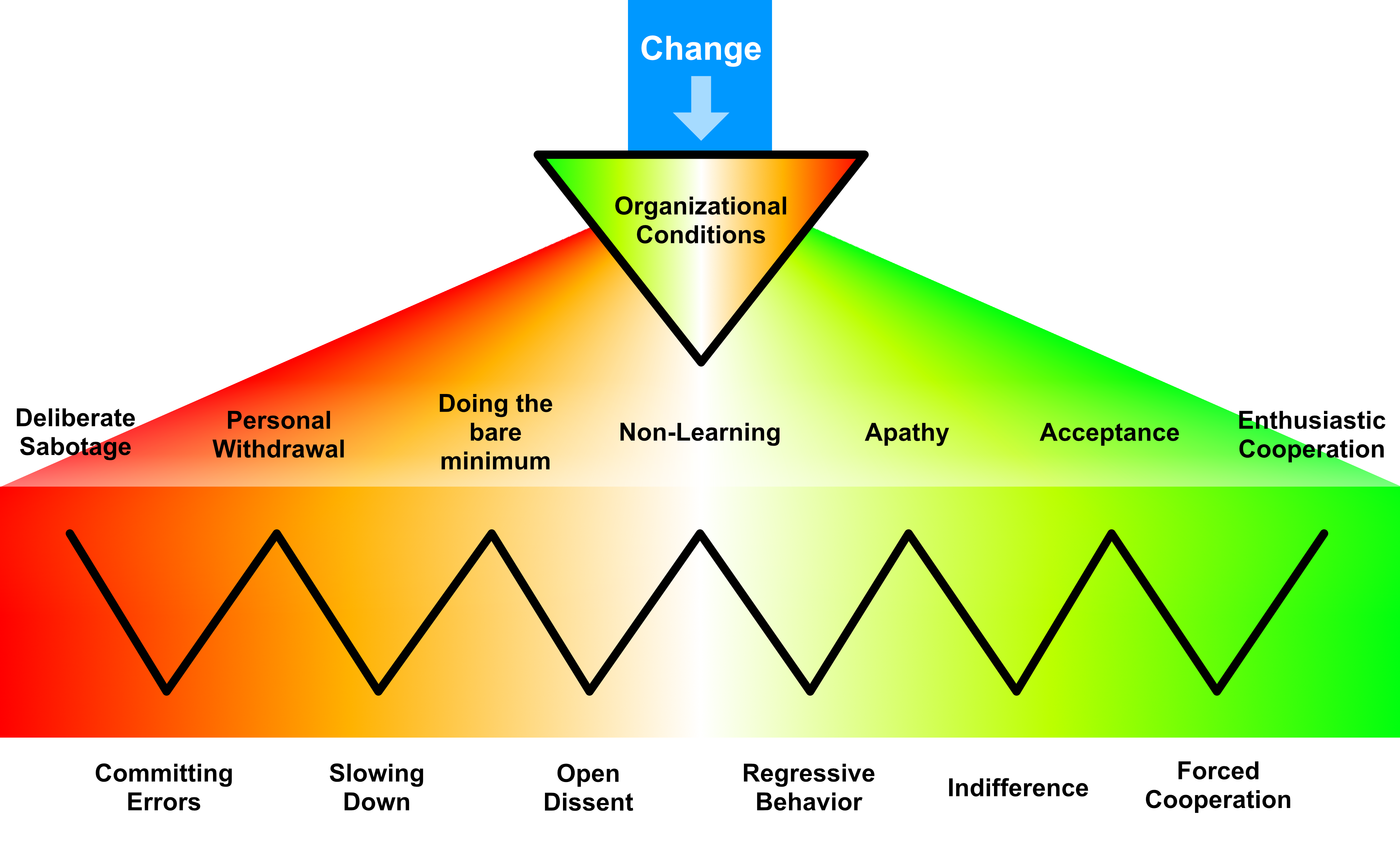

Change can come in many forms:
- New leadership
- New processes
- New tools
- New team members
- New goals
- New pressures
- A raise, promotion, or demotion
- Turnover
- Personal life events
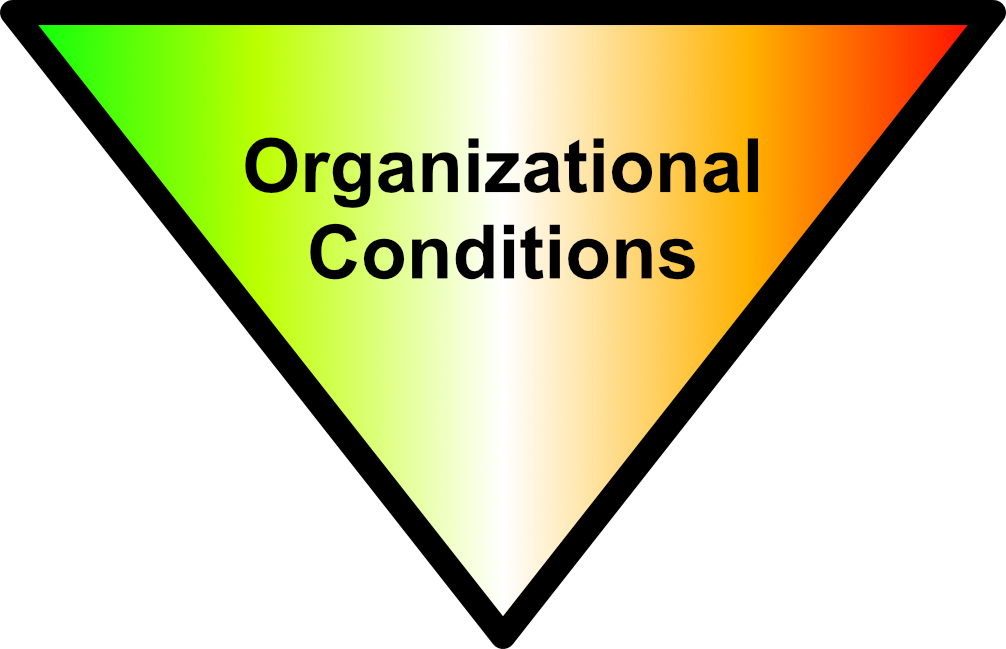
Changes flow into the "Organizational Condition" which is comprised of these types of factors:
- Culture
- Incentives
- Communication
- Trust
- Leadership
- Structure
These are the things that we can influence as leaders, managers, and individual contributors. They are the levers we can pull to help guide people through change. They are not guaranteed to work in 100% of cases, but they are the tools we have.
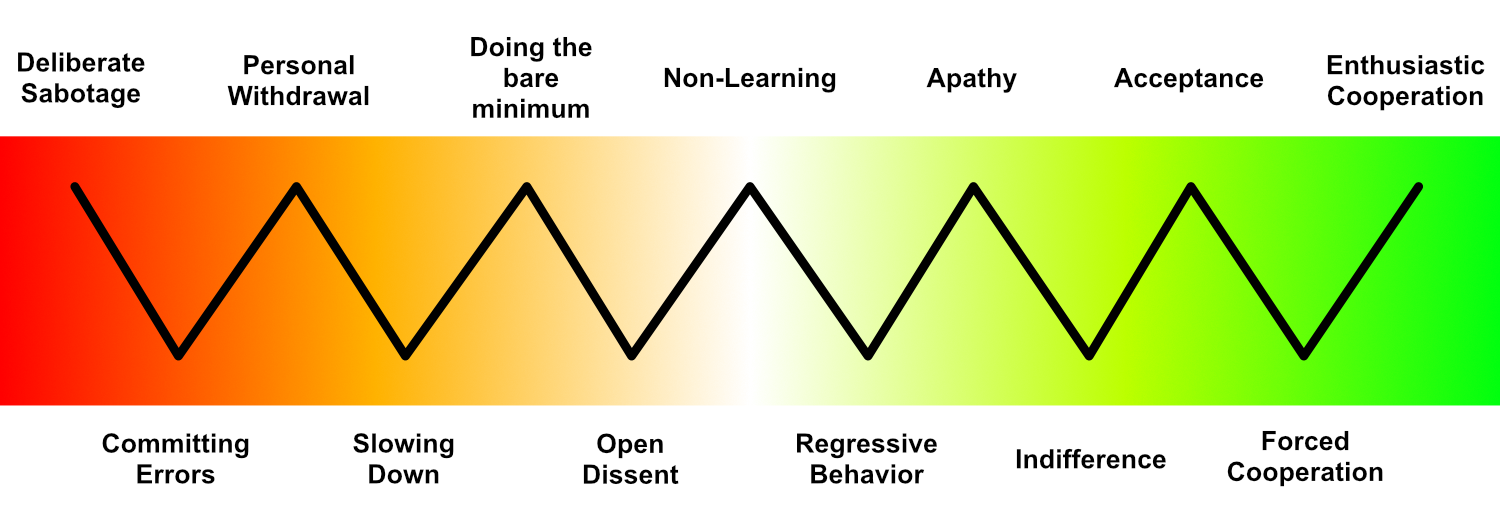
The spectrum itself is the hardest truth. You'll notice that there's really only ONE positive behavior on here: "Enthusiastic Cooperation."
Everything else from right to left is a progression towards deliberate sabotage. Other diagrams you'll find have positive behaviors in the middle somewhere, that aren't "as good" but are "okay." The reason I did it my way, is that from my experience, managing engagement is a constant battle, and one of the core functions of management itself. We have to remain vigilant, and anytime your team starts to move left, you have to be paying attention because enthusiastic cooperation is the only way teams can truly thrive and grow. Change management is just simply a hard thing to do, and it's a job that's never done.
Another factor to consider is time. Some people move along the spectrum quickly, and others could take years to move from one section to another. What I've seen is the more drastic the change is introduced in a business, typically the faster people's engagement behaviors will move around in response to the organizational conditions.
And lastly, I will not say that everyone will exhibit all of these behaviors in exactly this way and in this order, given enough time and change. I don't believe that is the case. There are people who are innately self-driven enough and genuine hard workers who would never deliberately sabotage the team under any circumstance. However, they can certainly slow down, or show some apathy, or withdraw their engagement in other ways. Highly driven and self motivated people also tend to leave the teams they are in quickly, because they are high performers and the organizational condition isn't meeting their needs. This means that it's even more important to pay attention to the details of your team's behaviors.
What You Can Do
It's always possible that there are people who have checked out completely, no matter what perfect organizational condition you create. These are people who are not aligned with your company's purpose, and you can only offer up so many chances, but they will continue moving left on the spectrum until you put a stop to it.
Below are specific things, for people still aligned with your company's purpose, that I've put together for each segment, instead focusing on you as the variable, and not blaming the person exhibiting the behavior. This is because you can only control yourself, and if you can change your approach, you can often change the organizational condition enough to move people back to the right.
If a team member moves right on the spectrum and exhibits more and more engagement, you must be prepared to keep the momentum going and keep them challenged. It can be hard for others to trust them if they've been stuck in low engagement for a while, so lead by example and trust them first.
Enthusiastic Cooperation
What it is: People actively support the change and help improve it, all on their own initiative. They go above and beyond, and help others get on board too.Recommendation: Protect this group with everything you've got. Keep giving them visibility into the business, influence in the process, and permission to lead others. One tangible way of doing this is becoming a certified B-Corp, profit sharing, or employee ownership.
Forced Cooperation
What it is: You feel like you have to ask people to do things they should be doing on their own.Recommendation: You may be leaning too hard on authority. Reduce mandates where possible and restore ownership by letting other people make decisions that can impact you, and them.
Acceptance
What it is: People acknowledge the change and comply without resistance.Recommendation: People may not feel safe to express concerns, or they've given a lot of repetitive input signaling that you're not listening. The best way to fix this is to actually follow through on their feedback. The moment you don't, acceptance moves left to indifference.
Indifference
What it is: People coexist with the change but feel no personal stake in it.Recommendation: You might be focusing on irrelevant metrics or goals, and your team is done trying to change them at this point because you're probably not paying attention. You need to reconnect with your team, and have them set your goals together.
Apathy
What it is: People appear emotionally neutral and indifferent to outcomes, good or bad.Recommendation: Show how today's actions affect real results, customers, or teammates. It's possible people on your team are burned out or don't feel like they're growing anymore. You need to ask them more questions about themselves and their aspirations in 1:1s, and get them excited about their own future again by taking an interest in them.
Regressive Behavior
What it is: Under pressure, people revert to old habits and processes.Recommendation: This is a stress response. Pressure creates diamonds or compact garbage. You might not be doing enough to support your own team, and they are falling back to what they know in a new situation. How can you project calm and confidence? When's the last time you've given them a break or celebrated a win?
Non-Learning
What it is: People continue old behaviors and avoid developing new skills.Recommendation: Make learning unavoidable and practical. Your team might be used to doing the same thing over and over, and the new change is that they have to do something new. Their possible failure might be a large source of fear of repercussions. Create small, low-stakes opportunities to practice new skills together, and reward effort over outcome publicly.
Open Dissent
What it is: People openly challenge decisions at the wrong times or in unproductive ways.Recommendation: Your team might be fed up with inaction, so they'll challenge things anywhere they can as a last resort. The mistake is trying to reduce dissent, instead of giving it structure at the right time. Have regular retrospectives, feedback sessions, and office hours where dissent is encouraged, respectful, and results in action and not a trash can.
Doing the Bare Minimum
What it is: People do exactly what is required and nothing more.Recommendation: This is a pivotal point on the engagement spectrum. Your team might feel like cogs in a machine, and aren't connecting with the company's purpose. It's time for you to have a crucial conversation with them to figure out what's going on.
Slowing Down
What it is: Work continues, but momentum is slowing on projects, and everything, even basic tasks, take longer than they used to.Recommendation: Remove friction fast. Pick one obvious blocker and eliminate it publicly to signal urgency and support.
Personal Withdrawal
What it is: People disengage emotionally while still showing up physically.Recommendation: This is a warning sign of lost trust, or deeper personal issues. You need to have honest, empathetic 1:1s to understand what's going on, because this is often a symptom of them either looking for another job, or something else outside your control.
Committing Errors
What it is: People are attempting to do the work, but repeated mistakes create risk, rework, or downstream impact.Recommendation: This is very low on the engagement spectrum, and you have to be decisive because it's directly impacting the business. Treat this as a role-fit or expectation reset. Set a short, explicit performance window with clear success criteria, and be prepared to change their roles or remove them if there's no change.
Deliberate Sabotage
What it is: Intentional actions that undermine the change, damage trust, or harm team outcomes.Recommendation: At this point, their behavior is doing harm, and "let's understand where they're coming from" is no longer a valid approach. You need to take swift action to remove them from the team, and communicate clearly why this behavior is unacceptable. You may be doing the best thing for them on a personal level than you realize.
Final Thoughts
This framework isn't meant as an attack or a way to assign blame. It's a tool for introspection to examine how your own actions shape the organizational conditions around you, and how those conditions influence engagement. My hope is that it helps put language to things you may already be sensing about your team, or even about your own engagement. There are countless variables at play in any organization, so this focuses deliberately on the one you can most directly control: creating the conditions that allow people who already care about the mission to navigate change effectively.
The best thing you can do is engage with your team often, really pay attention to what they're saying, and take action based on their feedback.